The airspace over Germany is cut into layers, and each layer has its own rules: who may enter, who has to ask first and who is responsible for keeping aircraft apart. Four classes remain, plus three special zones. Once you have understood the system, you read the ICAO chart differently.
Four classes, not seven
ICAO defines classes A to G. Germany uses four of them: C, D, E and G. A and B do not exist here, and class F was abolished on 11 December 2014 – it was replaced by airspace E and the newly introduced RMZ.
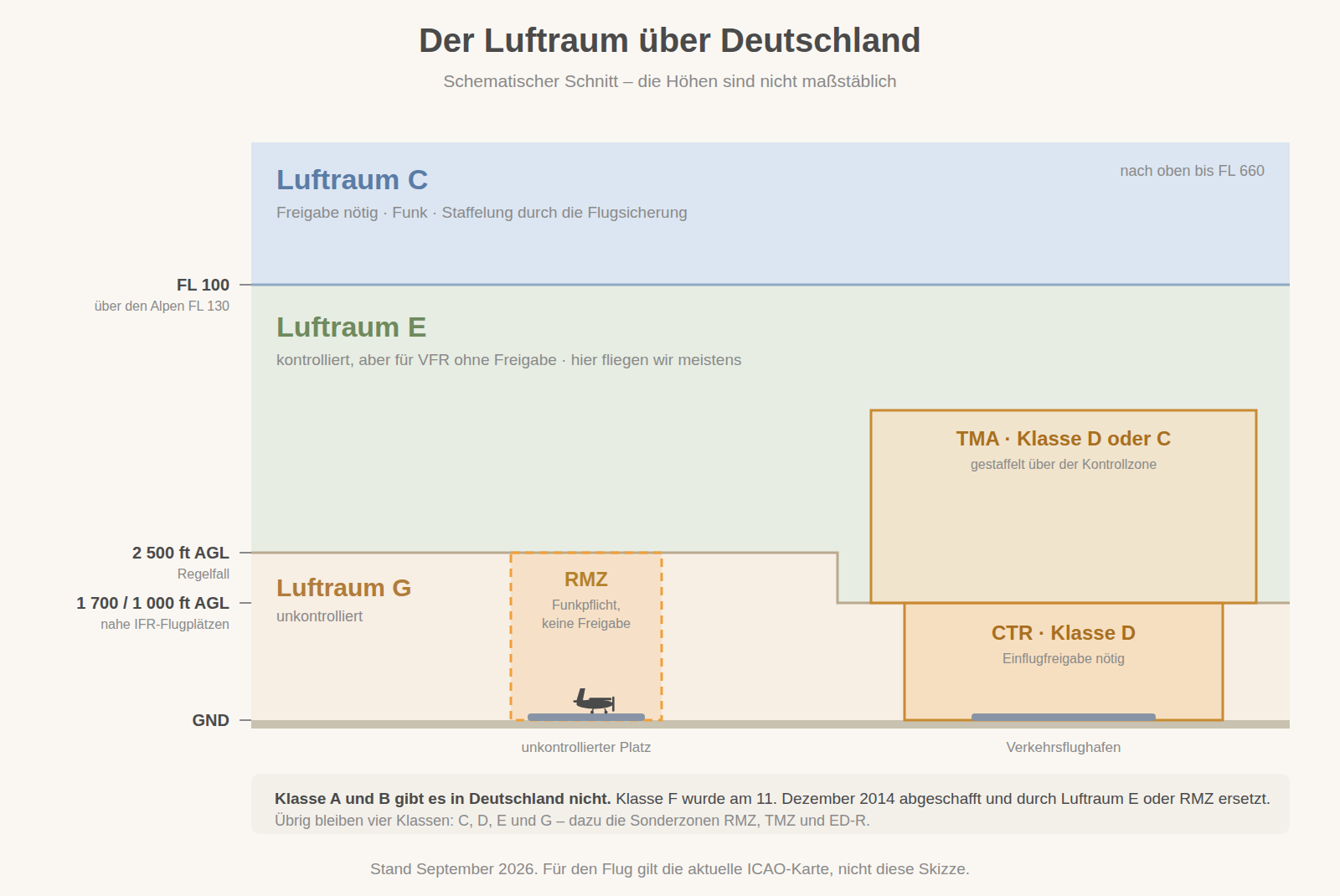
- Class C – from FL 100 up to FL 660, over the Alps only from FL 130. Plus the upper terminal areas of the large airports. VFR is permitted, but only with clearance and continuous radio contact; air traffic control separates the traffic.
- Class D – the control zones from the ground up and the terminal areas above them. Nothing works without an entry clearance.
- Class E – from 2,500 ft above ground to FL 100, near airfields with IFR traffic already from 1,700 or 1,000 ft. Controlled airspace – but VFR may enter without clearance and without radio. This is where most of our flights take place.
- Class G – from the ground to the base of E. Uncontrolled; everyone looks out for everyone else.
Three special zones
Besides the classes there are zones that trigger a single additional obligation – and only that one. Keeping them clearly apart saves a lot of uncertainty.
- RMZ – radio mandatory. Report before entering, maintain a listening watch, report leaving. No clearance is required, and nobody separates you.
- TMZ – transponder mandatory, with altitude reporting. You do not have to talk.
- ED-R – restricted area. Some are permanent, others only active at certain times; the active areas are listed in the DFS WebAUP.
What applies everywhere
- Speed limit 250 kt IAS below FL 100 – not a practical limit for us, but it explains why traffic is slower there.
- Transponder above 5,000 ft MSL or 3,500 ft above ground, whichever is higher. Always at night. The VFR code is 7000.
- Visual meteorological conditions differ by class and altitude – in airspace E below FL 100 they are 5 km flight visibility with 1.5 km horizontal and 1,000 ft vertical distance from cloud.
What this means for flight planning
- Go through the route layer by layer, not only on the map. The question is not just where I fly, but what lies above me and where a base drops lower.
- The lowered E bases are the most common pitfall. 2,500 ft above ground is the default, not the rule – around airfields with IFR traffic the base is lower.
- Airspace boundaries change every year, in 2026 on 19 March. Paper chart and the database in your navigation device must be updated together, otherwise they contradict each other in flight.
- Clarify special zones in advance. An RMZ costs a word, a TMZ a code, an ED-R a decision – but you do not want to discover any of the three en route.
As of September 2026. Airspace boundaries change regularly, most recently on 19 March 2026. The current ICAO chart and the AIP VFR are binding – not this page.
Remember
Controlled does not mean clearance required. Airspace E is controlled airspace – and yet you may enter it without asking.