
Carburettor icing is the weather phenomenon that happens in the engine bay. It has nothing to do with frost: the most dangerous day is mild, humid and looks harmless. And it does not announce itself – it creeps up on you.
Why ice forms in the carburettor

Two things happen in the carburettor at the same time, and both cost heat. In the venturi the cross-section narrows, the pressure drops, and falling pressure cools the air. Shortly afterwards the fuel evaporates and draws further heat from the air. Together this can amount to 20 to 30 degrees. If there is enough moisture, it is deposited as ice – first at the narrowest gap, that is at the edge of the throttle valve.
When it becomes critical
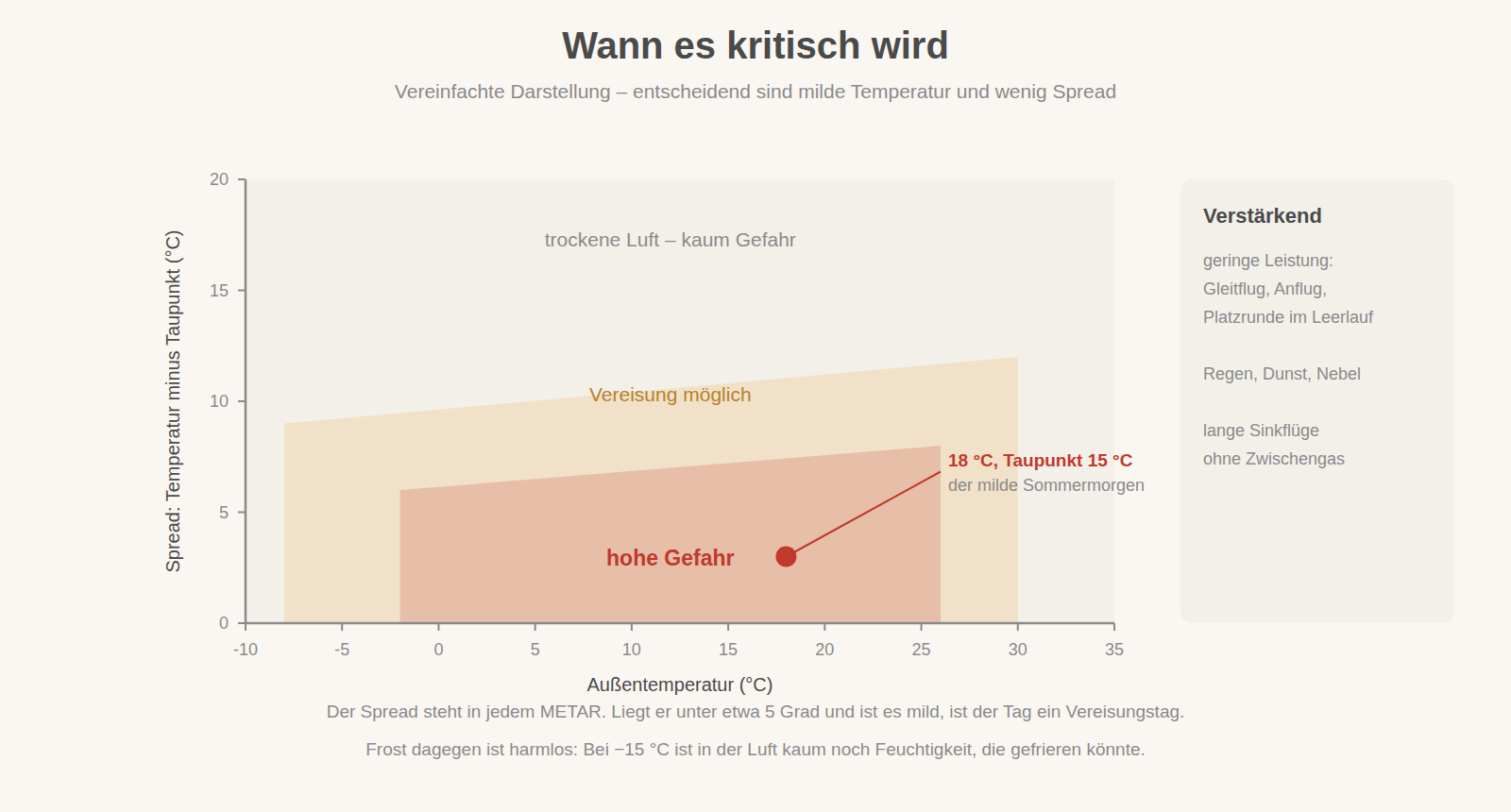
- Mild and humid is dangerous, cold and dry is not. Between about 0 and 25 degrees with a spread of less than 5 degrees lies the uncomfortable range – the mild summer morning after a damp night.
- Low power makes everything worse. With the throttle almost closed, a little ice is enough to block the gap. Gliding, long descents and circuits at idle are the critical phases.
- Visible moisture is an amplifier, not a prerequisite. Rain, haze and fog increase the risk, but clear air with high relative humidity is quite enough.
How to notice it
- Fixed-pitch propeller – the RPM drops slowly without anyone having touched anything. That is the first and often the only sign.
- Variable-pitch propeller – the manifold pressure drops while the RPM initially stays the same.
- After that rough running, noticeable loss of power, in the extreme case misfiring up to engine stoppage.
- The process is gradual. Many only notice it at the moment they want to open the throttle – and that is exactly when nothing happens.
The Rotax 912 is considered less susceptible than a Continental or Lycoming because the Bing carburettors sit close to the warm engine. Less susceptible does not mean immune, and many ultralights have no effective carburettor heat. If you have none, in an emergency you can only add power and leave the area – which is why, with these types, avoidance is the whole strategy.
What this means for a flying day
- Look at temperature and dew point before take-off. Both are in the METAR. Mild and close together means: today is an icing day.
- Pull the carb heat before reducing power, not afterwards – that is, before the descent and before the circuit. And then fully, not just a little.
- It gets worse briefly before it gets better. The melted water runs through the engine, which runs rough for a few seconds. That is the proof that there was ice – not a reason to switch the carb heat off again.
- In a long glide, open the throttle briefly every few minutes. That keeps the engine warm and tells you whether it is still there.
- If the RPM drops slowly, think of icing first, not of fuel. Reaching for the carb heat costs nothing and settles the question in half a minute.
Remember
Carburettor icing is a fair-weather problem. The most dangerous day is 15 degrees, high humidity and not a single cloud to warn you.