Around every commercial airport lies an upside-down wedding cake: narrow at the bottom, wider upwards and outwards. At the very bottom the control zone, above it the stepped layers of the terminal area, and above everything, from FL 100, airspace C. All three have one thing in common – nothing works without clearance.
The cake from bottom to top
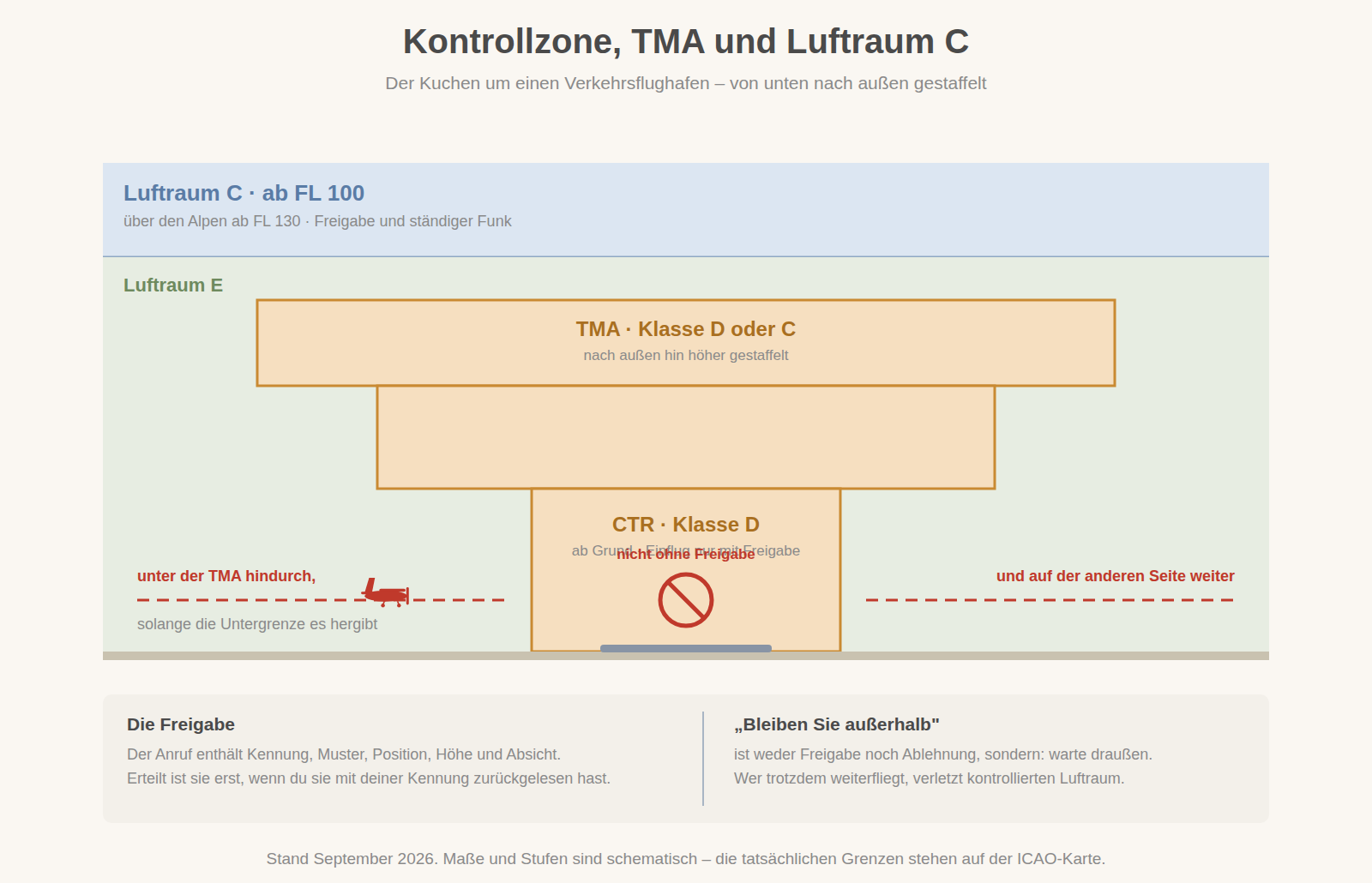
- CTR – the control zone, class D, from the ground. It protects arrivals and departures. Anyone who wants to enter needs a clearance, and before reaching the boundary.
- TMA – the terminal control area, class D or C, above the control zone and rising outwards in steps. That is why at a large airport you can often fly around the outside or underneath without ever needing a clearance.
- Airspace C from FL 100, over the Alps from FL 130. VFR is permitted, but only with clearance and continuous radio contact – and air traffic control actively separates you from other traffic there.
How a clearance comes about
The call contains four things: who you are, where you are, how high you are and what you intend to do. Then you wait. The clearance is only granted once you have read it back with your callsign – before that it does not exist, even if you heard it.
The sentence behind most misunderstandings is "Bleiben Sie außerhalb der Kontrollzone" (remain outside the control zone). It is neither a clearance nor a refusal, but an instruction to wait. Anyone who keeps flying infringes controlled airspace – and that is not a trivial offence but an administrative offence that will be reported.
Why this is still the milder variant: entering controlled airspace remains an administrative offence; entering a restricted area is a criminal offence. The comparison is on RMZ, TMZ and ED-R.
The way without clearance
You do not have to go in. Under the TMA steps there is almost always a corridor, and you can always go around the outside. Both need planning in advance: the corridor under a TMA step can become narrow if at the same time the base of airspace E drops and there are obstacles underneath.
What this means for a flying day
- Call early enough. Rule of thumb: five minutes before the boundary, not five seconds. The controller needs time, and you need a plan B.
- Have plan B before you call. If the answer is "remain outside", the way around must already be in your head – otherwise the holding pattern turns into an airspace infringement.
- Read back what concerns you: clearances, altitudes, transponder codes and taxi instructions. Acknowledge everything else briefly.
- When passing under a TMA step, watch your altitude. The step is a hard limit; the 200-foot buffer you allow yourself costs nothing.
- When in doubt, ask rather than dither around the edge. A refused entry is harmless; an unnoticed infringement is not.
As of September 2026. Airspace boundaries change regularly, most recently on 19 March 2026. The current ICAO chart and the AIP VFR are binding – not this page.
Remember
A clearance only exists once you have read it back. And "remain outside" means wait, not keep going.