In the Alpine foothills the large-scale weather situation is not enough. Two local wind systems are superimposed on it and on many days matter more than anything on the surface chart: the foehn and the daily up and down of valley and mountain winds.
Foehn: warm, clear and dangerous
Foehn occurs when a strong airflow is forced across the main Alpine ridge. On the windward side the air rises up the mountains, cools, condenses and rains out – orographic rain. Over the ridge the cloud stands as the foehn wall. In the lee, the now dry air descends and warms more strongly than it cooled on the way up. The result is the familiar foehn situation: unusually warm, extremely dry, crystal-clear visibility all the way to the mountains.
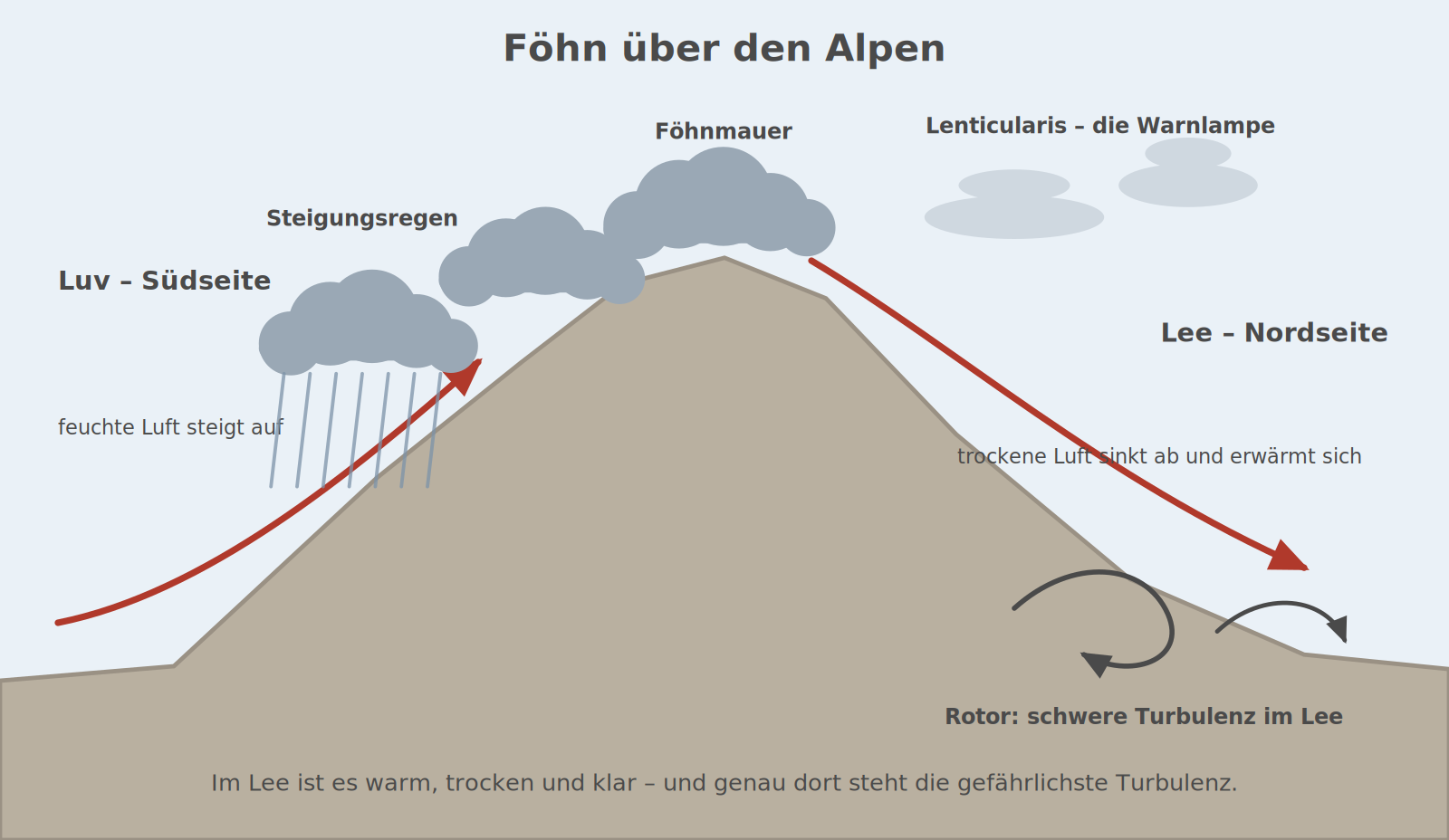
That very clarity is the trap. The foehn is a storm you cannot see. Aloft there are wind speeds far above what reaches the ground; in the lee of the ridges rotors with severe turbulence form, and in the valleys the wind breaks through in gusts. The visible signs are the smooth-edged lenticular clouds over and behind the mountains, which stay in the same place despite strong winds, and the foehn window: the strikingly clear strip north of the Alps.
Valley wind and mountain wind
On calm, sunny days a separate wind system develops, driven by the sun alone. During the day the slopes warm faster than the free air at the same height. The warm air rises up the slope and air flows in from below – the valley wind blows up the valley and up the slopes. It sets in late in the morning and reaches its greatest strength in the afternoon, in the Inn or Isar valley easily 15 to 25 knots.
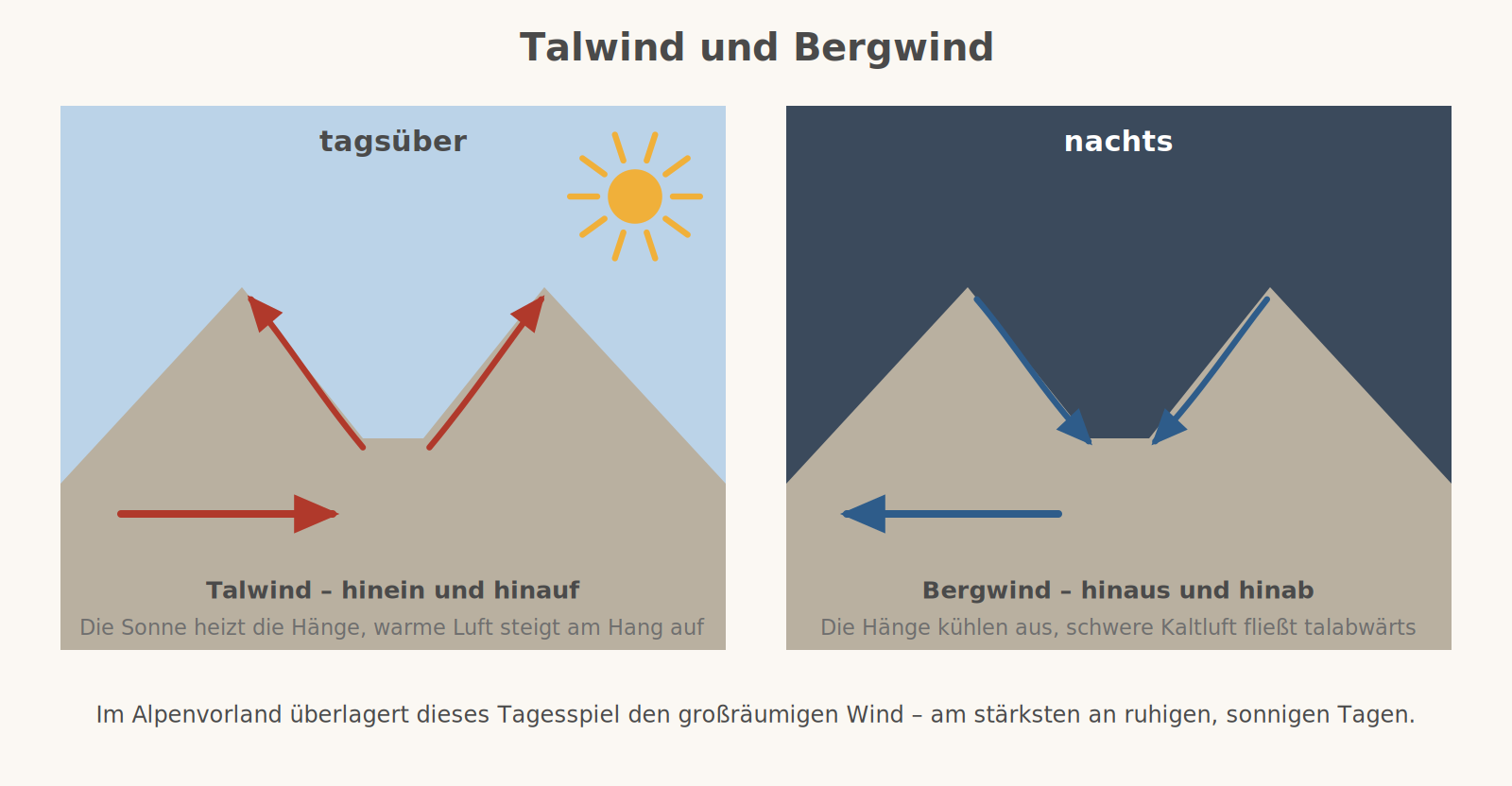
At night everything reverses. The slopes cool, the heavy cold air flows down the slopes and out of the valley – the mountain wind. In basins it collects into a pool of cold air above which fog forms.
Rules for the valley
Foehn and valley winds explain what the air in the valley is doing. These four rules tell you what to do yourself – they come from mountain flying and have saved more lives than any weather chart.
- Never fly into a valley whose exit you cannot see. A valley that closes behind a bend or ends in cloud leaves you only the option of turning back – and that needs space.
- Do not fly in the middle of the valley but on the right-hand side. That leaves the whole width of the valley for the turn-back and keeps oncoming traffic on its side.
- The turn-back starts towards the middle of the valley, never towards the slope. Turned towards the slope, the radius becomes a trap.
- Before entering, decide at what altitude you will come out again. An ultralight climbs more slowly in the valley than the slope rises – you gain the altitude beforehand, over open terrain.
What this means for a flying day
- In foehn, visibility is no argument. The most beautiful day of the month can be the least flyable. Lenticular clouds over the mountains and a striking jump in temperature are the signal to stay at home.
- The rotor lies in the lee of the ridge. With south foehn, therefore, on the north side – exactly where you are flying in the mountains.
- Valley wind means: the landing direction changes during the day. If you took off in one direction in the morning, you often land in the other in the afternoon.
- In the valley, fly on the sunny side. That is where the air goes up; on the shady side it sinks. And always so that a turn-back into the valley is still possible.
- The valley wind overrides everything. Even if the forecast for the airfield says calm: in the afternoon the valley wind will be blowing.
- Mountain flying needs proper instruction. This page is no substitute for a briefing by an instructor; it only explains why you need one.
Remember
Foehn: clear visibility, warm air, invisible storm. Valley wind: in and up by day, out and down by night.