An emergency beacon is the only device on board that only starts working when everything else is over. Whether it helps is not decided in the crash but beforehand — at registration and with a look at the battery expiry date.
As of: September 2026. The basis is the information from the German Federal Aviation Office (LBA) on ELTs. What applies to your aircraft depends on its approval and type of operation; when in doubt, ask your inspector, not this page.
406 and 121.5 belong together
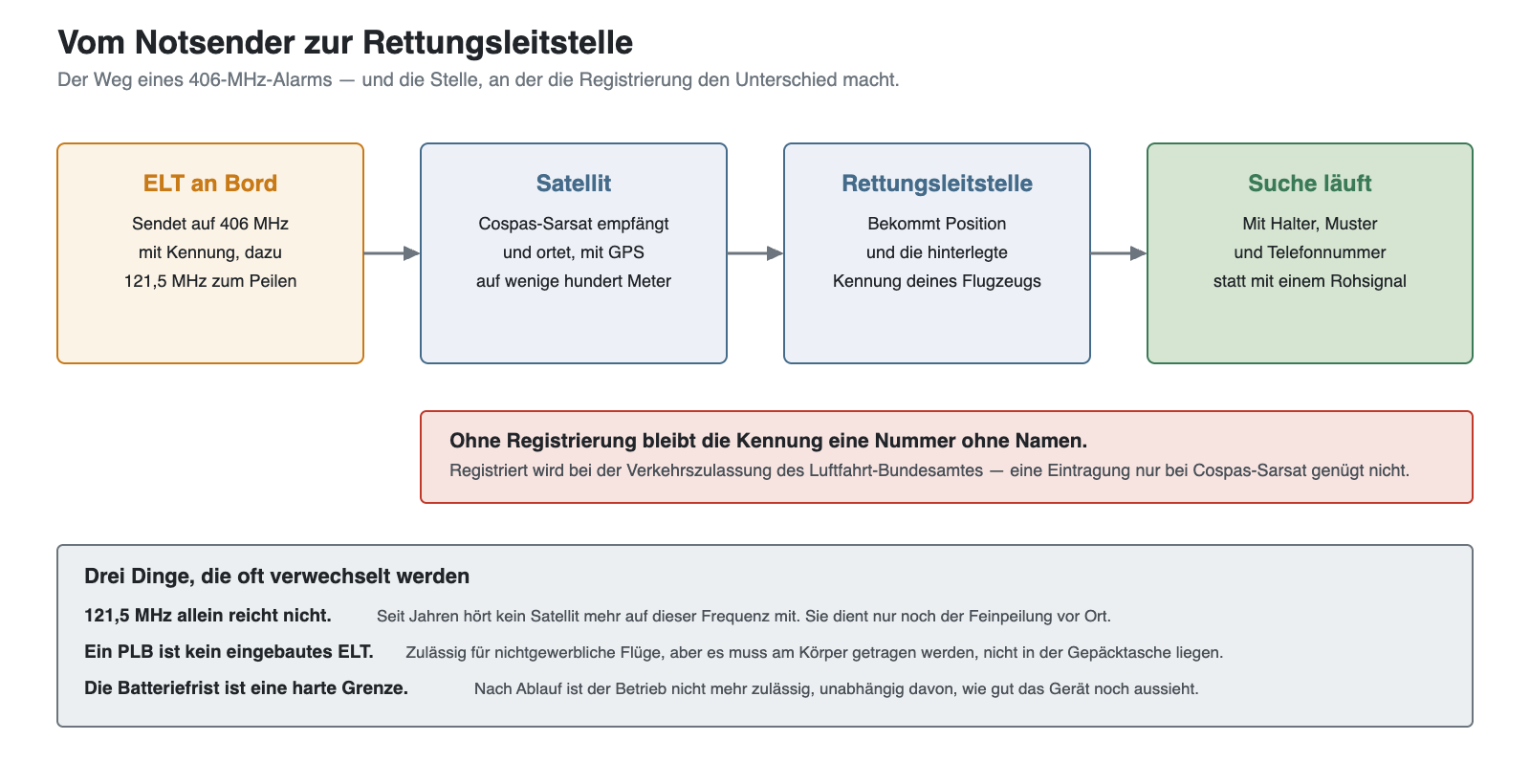
A modern emergency beacon transmits on both frequencies at the same time. On 406 megahertz the digital signal with its identifier goes to the satellites, on 121.5 an analogue tone with which search teams take bearings on site. Devices that use only one of the two frequencies are no longer permitted — a pure 121.5 beacon is no longer heard by any satellite.
Registration: the step that counts
The identifier your ELT transmits is at first just a number. Only registration links it to owner, type and phone number. In Germany it is done with the aircraft registration department of the Federal Aviation Office; an entry in international databases alone is not sufficient.
In practice this means: the rescue coordination centre first calls the number on file. If it is wrong or out of date, the search begins with the question of who this signal belongs to at all. After a change of owner, a new phone number or a device replacement, the entry must therefore be updated.
ELT or PLB
The PLB is the handheld device. For non-commercial flights it is permitted as an alternative, but under one condition that is often overlooked: it must be worn on the body. In the bag behind the seat it is useless if you can no longer reach the luggage.
The difference in an emergency: the installed ELT triggers automatically on deceleration; the PLB has to be switched on by someone. Both have their justification — the honest question is whether you would still be able to do it when it counts.
The battery expiry date
Every emergency beacon has a date on it. After that, operation is no longer permitted, regardless of how good the device looks or whether it still transmits in a test. That belongs on the same list as the periodic inspection and the repacking date of the rescue system, not in the category "someone will notice".
Abroad
Austria explicitly requires an ELT or PLB in its list of documents and equipment for ultralights. For Italy this applies through the equipment requirements of the advanced category. If you fly across borders, the topic is on your list anyway — the details are on the country pages under Airspace and Radio.
What this means for a flying day
- Keep the registration up to date, especially after a change of owner or a new phone number.
- PLB on your body, not in the bag.
- Note the battery date, together with the periodic inspection and the repacking date.
- After a hard landing, check whether the beacon has triggered — an unnoticed alarm ties up rescue services.
- Before a flight abroad, go through the destination country's list of required equipment.
Remember
The beacon does not find you. It tells others where to look — and who you are is only in the register.