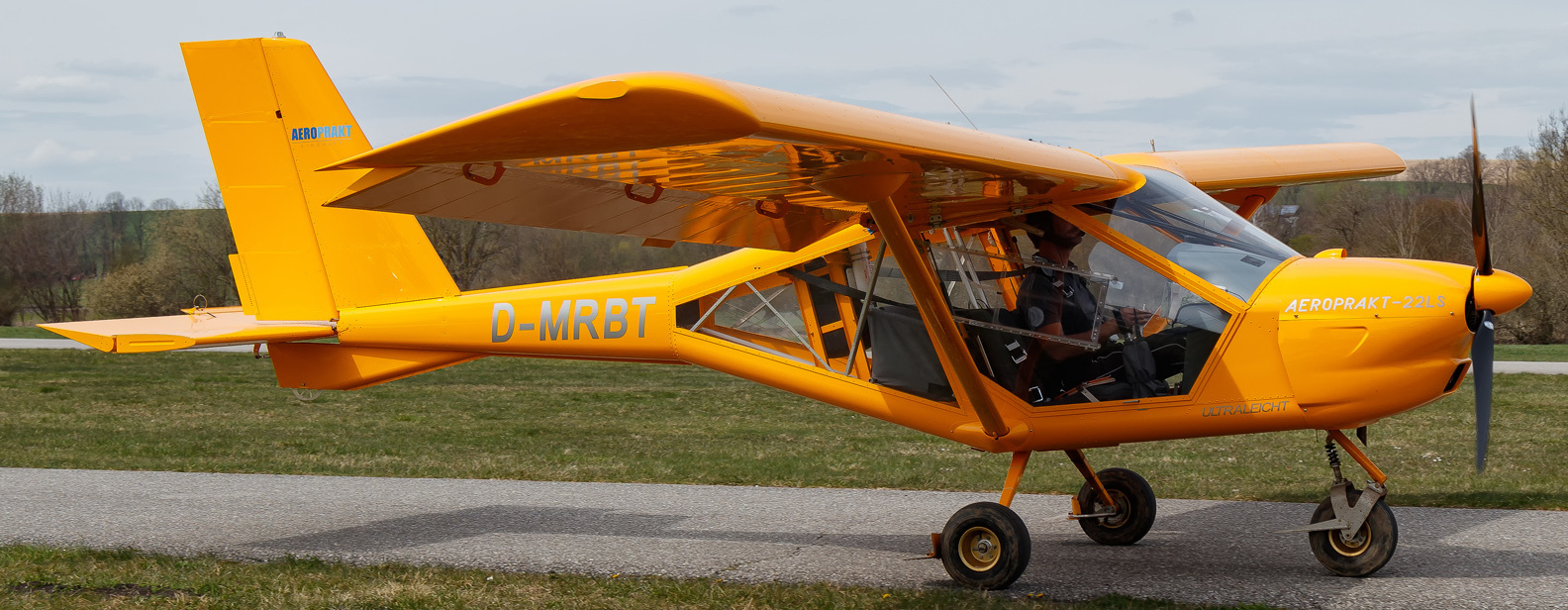
The 912 ULS forgives a lot, but it tells you everything it needs — through four gauges. If you know their limits, you understand why warming up is not a ritual and why take-off power is limited to five minutes.
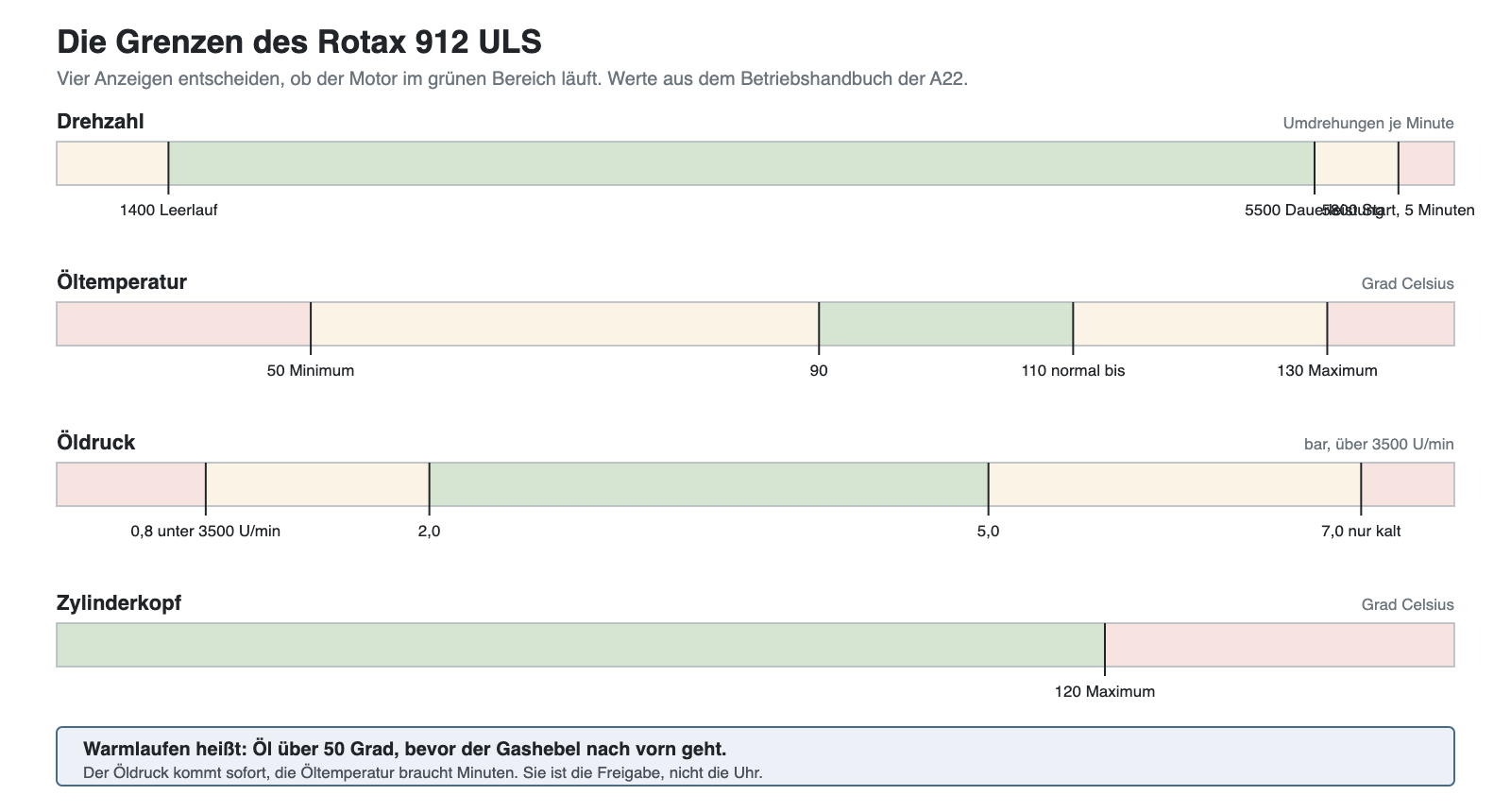
As of: September 2026. The values come from the operating manual of the A22 with Rotax 912 ULS. For your aircraft your manual applies, and for the engine the Rotax documentation.
Four numbers that count
- RPM: idle 1400, continuous power up to 5500, take-off power 5800 for a maximum of five minutes.
- Oil temperature: at least 50 degrees, normal 90 to 110, maximum 130.
- Oil pressure: 2.0 to 5.0 bar above 3500 RPM, below that at least 0.8. On a cold start up to 7.0 bar is briefly permitted.
- Cylinder head: maximum 120 degrees.
Why warming up is not a ritual
Oil pressure is there after seconds; oil temperature takes minutes. The two measure different things: pressure says that oil is flowing, temperature says that it is thin enough to get everywhere. The 50 degrees are therefore not a recommendation but the clearance for high power.
The 912 has two cooling circuits — water for the cylinder heads, air and oil for the rest. When stationary, both lack airflow. Long ground runs at high RPM are therefore the surest way to high head temperatures.
The five minutes of take-off power
5800 RPM is a time limit, not a continuous rating. After the climb the lever goes back into the continuous range. In cruise the A22 runs at about 4500 RPM according to the manual — well below what the engine can take, and exactly where it lasts a long time.
The gearbox and the propeller
Between crankshaft and propeller there is a reduction gearbox with a slipping clutch. It does not like load changes on the ground or sudden bursts of throttle. Pushing gently instead of yanking is not a matter of style but of looking after the hardware.
Carburettors, not injection
Two constant-depression carburettors make the 912 simple and easy to maintain — and susceptible to icing. The topic has its own page under Weather Basics, because that is where it belongs: it is a weather issue with a technical cause.
What this means for a flying day
- Oil temperature is the take-off clearance. Below 50 degrees the lever stays back.
- On the ground, short and at low RPM. A ground run cools worse than any climb.
- After take-off, back to continuous power. The five minutes are over sooner than you think.
- Keep an eye on head temperature in the climb, especially in summer and over the mountains.
- After the flight, do not shut down immediately, but let it cool briefly at idle.
Remember
Oil pressure means the oil is flowing. Oil temperature means you may go.