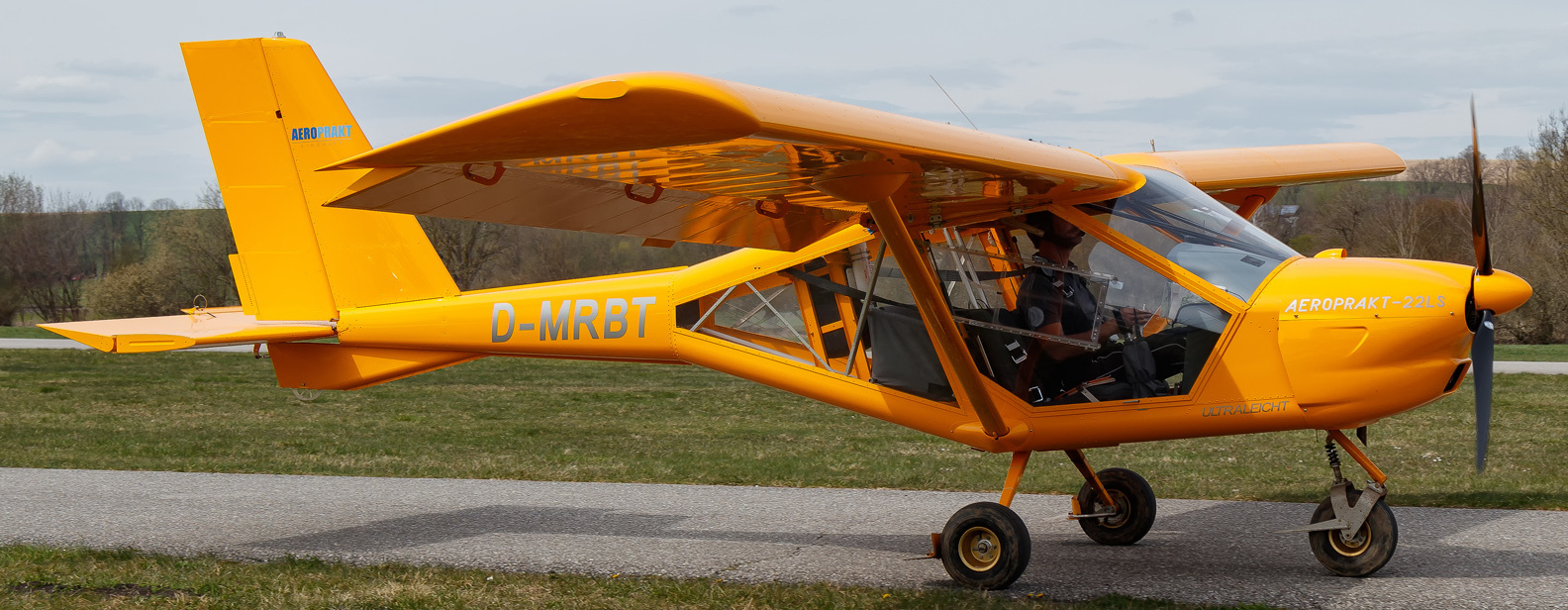
The flight manual value for take-off distance applies to a day that rarely exists: standard conditions, sea level, hard runway. Every step away from that costs metres — and on a grass field in midsummer the steps add up.
As of: September 2026. Base values and additions come from the A22 operating manual; the density altitude formula is a common rule of thumb. The figures in your manual for your aircraft and your load are what count.
What the manual says
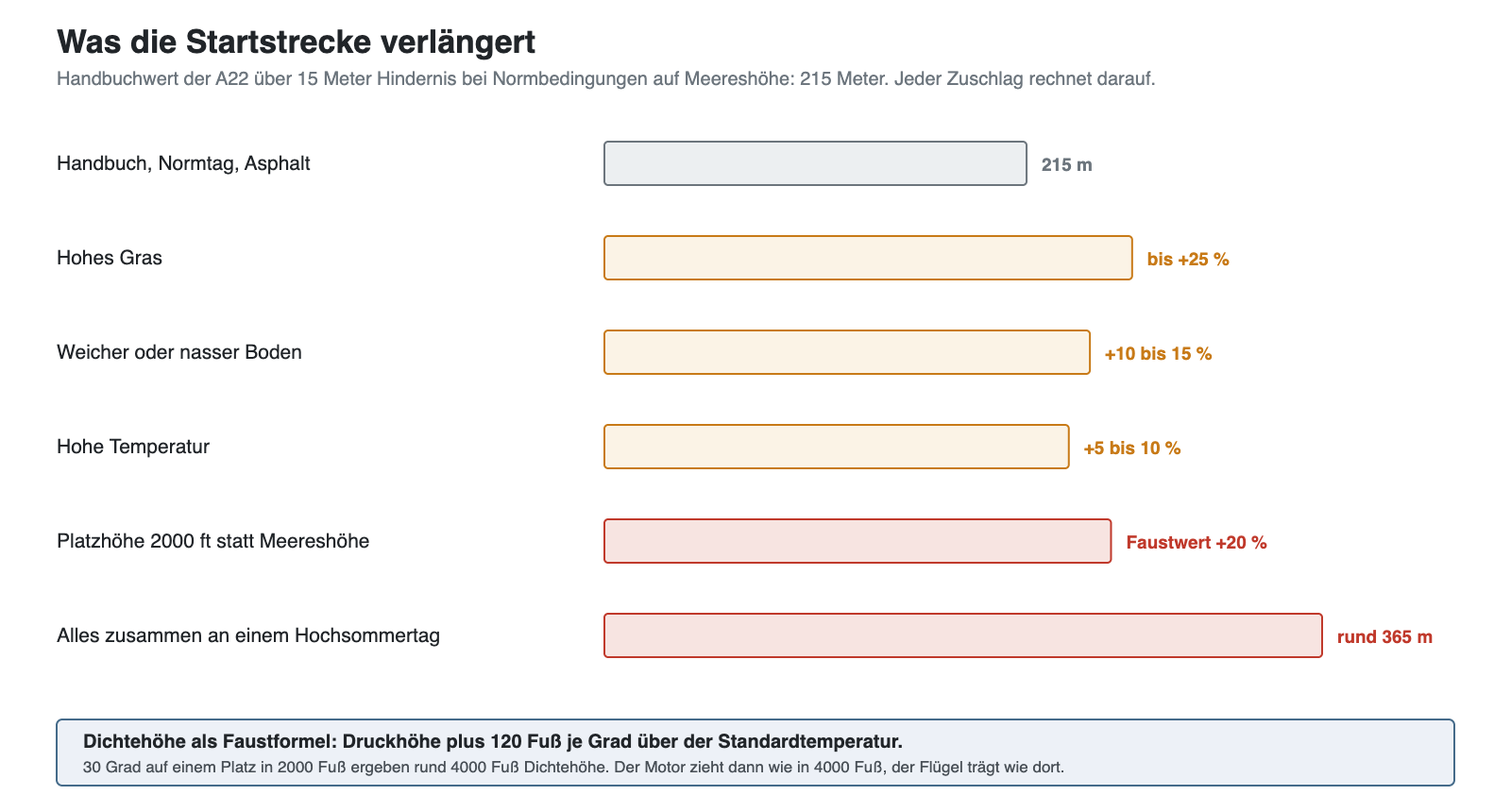
The A22 needs about 215 metres to clear a 15-metre obstacle, lands in less than 350 metres and climbs at least 3 metres per second. These values apply under standard conditions at sea level and at maximum mass. The manual gives the additions right alongside: long grass up to 25 per cent, dirty or soft runway 10 to 15 per cent, high temperatures 5 to 10 per cent.
Density altitude: the altitude the wing feels
The wing lifts according to air density, not according to the altimeter. When the temperature rises, the air becomes thinner and the aircraft behaves as if the airfield were higher. The useful rule of thumb: pressure altitude plus about 120 feet for every degree above standard temperature.
An example from the Alpine foothills: an airfield at 2,000 feet, 30 degrees in the shade. Standard there would be about 11 degrees; the difference is 19 degrees, which makes about 2,300 feet extra — the take-off takes place as if the airfield were at a good 4,000 feet. Engine, propeller and wing all work worse at the same time.
Three effects, one result
- The engine produces less power, because less oxygen goes through the carburettor.
- The propeller bites less, because it produces less thrust in thinner air.
- The wing needs more speed over the ground for the same lift — the indicated lift-off speed stays the same, the ground speed rises.
That is why not only the ground roll gets longer but also the climb afterwards. Anyone taking off from a valley on a hot day has both against them.
Grass is not just grass
The 25 per cent from the manual applies to long grass. Wet, freshly mown or soft grass lies in between, and a runway after three days of rain is a case of its own. Safe practice: calculate the least favourable addition you can imagine and set the abort point beforehand.
The abort point
One number in your head replaces any calculation after the fact: by which point on the runway must lift-off speed have been reached? If it has not, you abort — you do not pull. On short airfields you mark this point by a tree, a gateway or a sign.
What this means for a flying day
- In midsummer, take off early. At the same airfield the difference between eight in the morning and two in the afternoon is greater than any question of payload.
- Add the factors, do not average them. Grass, heat and airfield elevation apply together.
- Set the abort point before the throttle goes forward.
- Calculate Alpine airfields separately. 3,000 feet elevation and 25 degrees quickly give a density altitude above 5,000 feet.
- Filling up is a decision, not a habit — on short airfields every litre costs metres.
Remember
The altimeter shows where the airfield is. Density altitude shows where the aircraft thinks it is.