Wind and isobars explain where the wind comes from. In the circuit something else matters: how much of it is across the runway, what the gusts do to the approach speed and where the air becomes rough behind obstacles. An ultralight is light – it feels all of this more clearly than a Cessna.
The crosswind component in your head
You do not need a calculator. The angle between wind direction and runway direction, divided by 60, gives roughly the share that is across. 30 degrees is half, 45 degrees a good three quarters, from 60 degrees practically all of it. For a decision on the ground it does not need to be more precise.
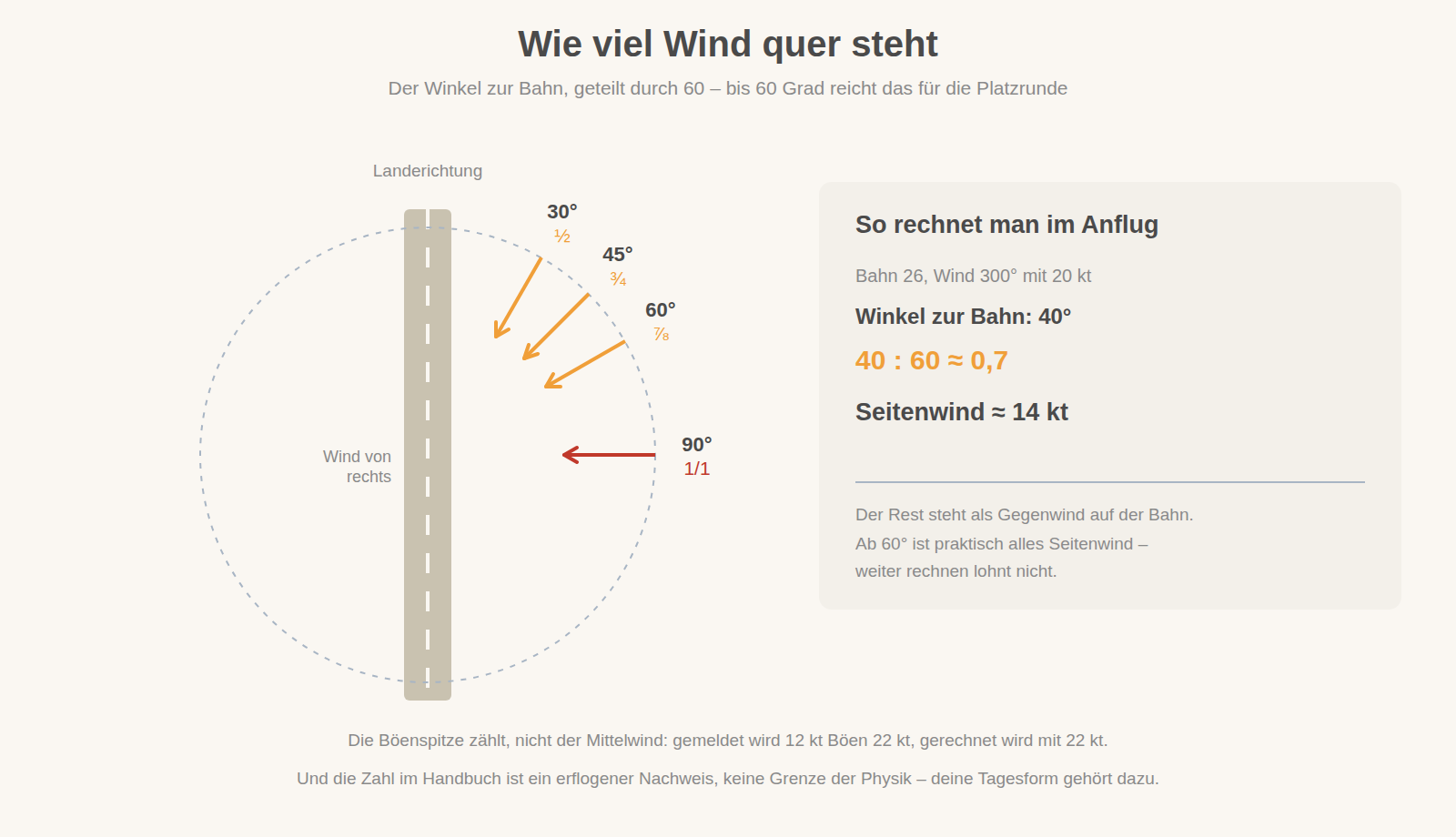
- Calculate with the peak gust, not the mean wind. With "12 kt, gusts 22 kt", 22 is the number that counts.
- The rest is headwind on the runway and shortens the landing distance – that is the good half of the sum.
- The figure in the flight manual is a demonstrated value, not a law of nature. It says what a test pilot managed on a good day, not what you can manage today.
Gusts go on top of the approach speed
The common rule of thumb: add half the difference between mean wind and peak gust to the normal approach speed. 12 kt gusting 22 kt gives five knots more. More is not better – too much speed means floating, and floating in gusts means that at some point you are left with neither speed nor runway.
Add to this setting less flap and keeping your hand on the throttle until touchdown. A gust that leaves you ten metres above the runway takes speed and lift with it at the same time.
Where the wind gets broken up
The reported wind applies to the free airflow. Behind every obstacle it turns into something else: swirling, sinking air that extends to about ten times the height of the obstacle. If the hangar is upwind of the threshold, that is exactly where the roughest spot of the whole approach is.
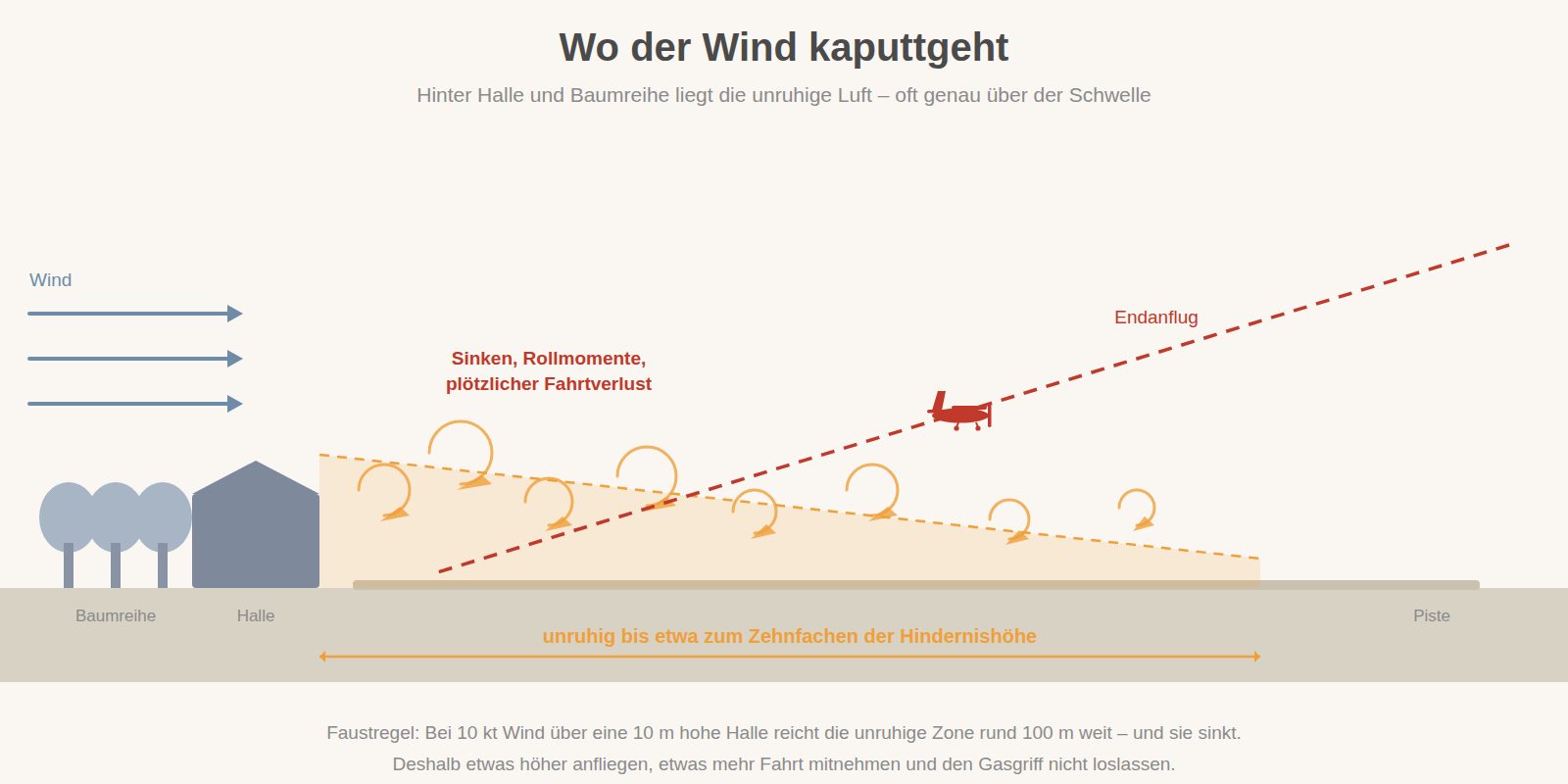
- Hangar, tree line, hedge – anything across the wind throws a rough zone behind it. It is not only turbulent, it also sinks.
- Slope edges and terrain steps have the same effect, only larger. Expect sink in the lee of a ridge and lift on the windward side.
- Shear – the wind at 500 ft is not the wind on the ground. With a surface inversion it can differ by 30 degrees in direction and by a factor of two in strength.
What this means for a flying day
- Look at the windsock, not just the number. It shows the gustiness and the variation in direction that no report conveys.
- With gusts: add half the gust difference, use less flap, keep your hand on the throttle.
- If there is an obstacle upwind of the threshold, cross it a little higher and move the touchdown point further in. The last hundred metres are the roughest.
- Crosswind above your own limit: the other runway, another airfield or another day. Your own limit is almost always below the manual's, and that is fine.
- Keep flying after touchdown. Aileron into the wind, elevator back until the aircraft has really stopped.
Remember
It is not the mean wind that gets you into trouble but the gust – and what happens behind the last obstacle before the threshold.