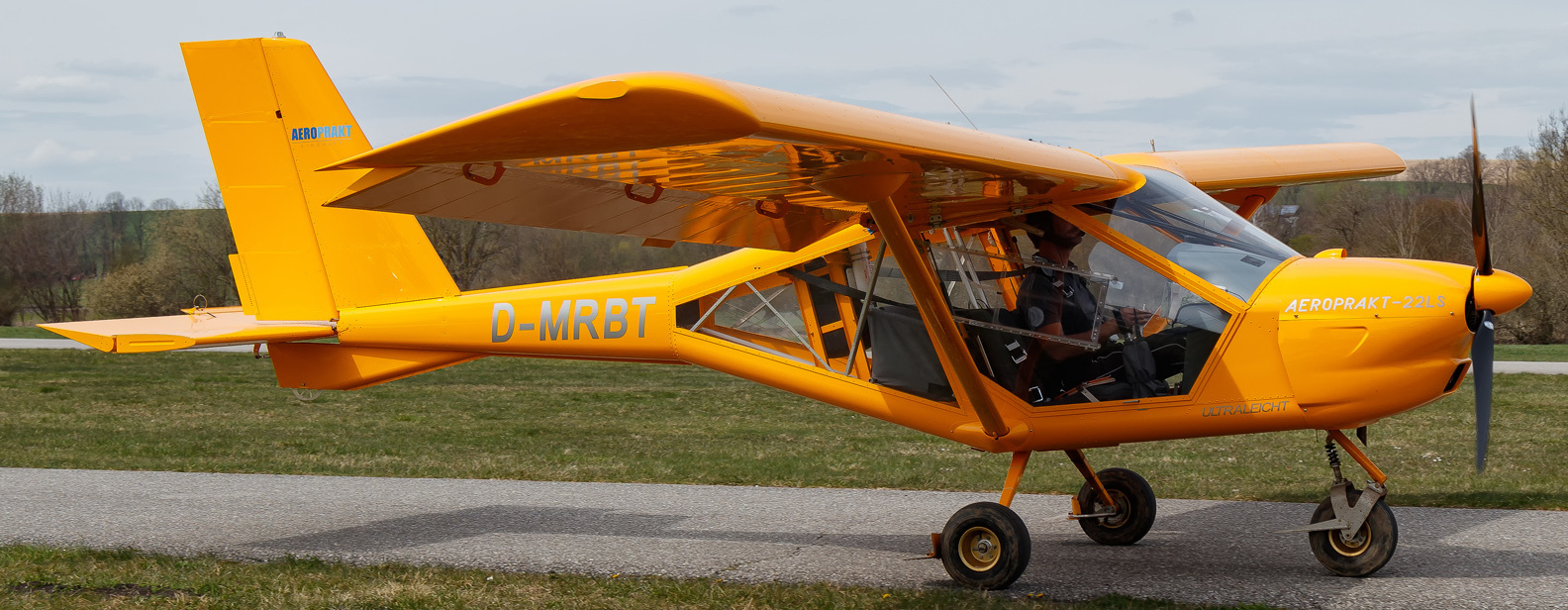
What safety notices apply to our D-MRBT, when what is maintained and what to watch out for with care and parking – compiled from the documents of Aeroprakt, Rotax and our flight manual.
On this page: Aeroprakt safety notices · Engine · Airframe maintenance schedule · Limits · Rescue system · Care and parking · Owner obligations · Summary
- TypeAeroprakt A-22LS, MTOM 600 kg
- Serial number / year338 / 2018
- Type data sheetDULV 991-22 1
- ControlsCentre stick "Y" with locking pin
- Tanks90 l, composite
- Rescue systemMagnum 601 Speed Softpack
- Tow hooknone
- EngineRotax 912 ULS
As of 17 October 2026, checked against the list at Aeroprakt Germany and the wording of the individual documents. The equipment is taken from the flight manual (section 9.2), serial number and year of manufacture from the adjustment report and the declaration of conformity of April 2023. This page is an overview – the original documents are binding; whether a measure has been carried out is recorded in the aircraft log and confirmed at the annual inspection.
Noticed when comparing with our flight manual: the text changes from SB A22LS-24 (brakes, sections 5.12/5.13) and SB A-22LS-27 (ethanol max. 5%, fuel sections) have not yet been entered in our copy "A22LS-338-POH" – it still says "avoid braking at high speed …" and "unleaded pump fuel, min. RON 95". Both need to be added and noted in the manual's list of amendments. In practice SB-27 means: do not fill up with E10, only Super (E5) or AVGAS 100LL – even though Rotax itself permits E10, the composite tanks cannot tolerate it.
Aeroprakt safety notices that concern the D-MRBT
Aeroprakt publishes safety directives (SA), service bulletins (SB), information bulletins (IB) and notices (N) for the A-22 family. The following apply to our serial number and equipment:
Applies to A-22LS with centre stick and locking pin between the seats from serial number 174 – so to us. If the aircraft is parked outside secured only with the pin, gusts acting through the ailerons can bend the front rod end of the elevator push rod; in the extreme case fatigue failure and loss of pitch control.
- One-off: remove the rod end, inspect for deformation and cracks, replace if necessary (GMM-4M-470), refit with a 1.6 mm washer at 10 Nm; approx. 3 h.
- Permanently: outside, never use just the pin, always also the control lock for the ailerons. The warning is already in our manual (section 8, tie-down).
Applies to every A-22LS with more than 500 flight hours or more than 5 years in service – built 2018, so due for us. The reason was fatigue failures of rudder cables.
- Inspect the cables at all fairleads and pulleys with a 30x magnifier and a bend test; a cable with broken wires or crackling when bent is replaced (cable set via the dealer).
- Check pulleys for free movement and fairleads for wear; set cable tension to 21 kg.
- The document gives no repeat interval – it makes sense to carry out the inspection at every annual inspection (this is also how it appears in our annual inspection checklist).
Applies to A-22LS 1 to 358. New inspection requirement in the maintenance manual (section 3.2): check the windscreen inside and out for cracks; if a crack extends beyond the mounting strips, the windscreen must be replaced. The PET-G glazing is not resistant to fuel, oil and solvents – use only suitable cleaning agents.
Applies to all A-22LS up to and including serial number 370. Moisture and insufficient lubrication at the bore for the steel bolt can trigger intergranular corrosion, and the bracket can disintegrate. Action: replace the bracket with the modified part and a new bolt (kit via the dealer, approx. 1 h). If corrosion is found, do not fly until it has been replaced.
Applies to all A-22LS up to and including serial number 394. The manufacturer of the coolant hoses changed the material; the hose at the inlet of the water pump can come loose in flight – overheating and engine failure are the result.
- Tighten the clamp to 4 Nm (remove upper and lower engine cowling, approx. 1.5 h).
- Recurring: first check after 25 h, then every 100 h – belongs in the "cooling system" checklist of the maintenance manual. The lower rear clamp is hard to reach and easily overlooked.
Applies explicitly to individual serial numbers in Germany, Denmark, Poland and Lithuania – no. 338 is on the list. Required by the manufacturer of the rescue system: an additional mount for the rocket housing with four screws and rivets (parts kit free of charge via the dealer, approx. 2 h). Without it, correct function on deployment is not ensured.
Applies to the A-22LS up to serial number 343 (list on the website) or 434 (text of the bulletin) – in both cases to us. Hard braking on asphalt can set the main gear legs into resonance; this can cause fatigue cracks in the rear web of the gear cross member.
- In the flight manual, sections 5.12 (normal landing) and 5.13 (short/soft-field landing), replace the sentence "avoid braking at high speed or with the nose wheel raised" with: "Avoid resonance vibrations of the main gear legs when braking!"
- In practice: brake gradually; if the landing gear starts to oscillate, release brake pressure immediately.
Applies to all A-22LS. The holes in the flaperon hinge bolts are not intended for split pins or locking wire – nothing may go in there, otherwise the aircraft no longer conforms to the approved design. Important above all for inspectors and workshops who "mean well".
Applies to 15 German A-22LS listed by name, including no. 338. This raises the aircraft from the old A-22L2 type data sheet (472.5 kg) to the A-22LS type data sheet with 600 kg MTOM: spring cables on the rudder pedals, new airspeed indicator markings (VNE 229 km/h), new placards (baggage 10 kg), new flight manual.
Done for us: adjustment report 15.03.2023, declaration of conformity from Aeroprakt Polska of 21.04.2023 (serial number 338, built 2018).
Applies to all A-22LS up to and including serial number 567 with glass-fibre reinforced plastic tanks. Ethanol attacks the epoxy resin of the tanks. New warning in the flight and maintenance manuals: fuel with more than 5% ethanol degrades the tanks and shortens their service life. For us this means: no E10.
To be checked on the aircraft
Applies to all A-22, A-22L, A-22L2 and A-22LS with the buckles shown in photo 1 of the bulletin (referred to on the website as "Czech buckles") – there is no list of serial numbers. Check: the marked part of the buckle must point away from the body when closed, and the straps must be sewn as in the drawings. The dealer replaces incorrectly sewn straps free of charge (send photos first).
According to the text, the complete conversion (new cables and intermediate fairleads, approx. 16 h) applies to A-22LS 1 to 328 – later aircraft such as ours already have the modified version from the factory. If the inspection under SA A22LS-16 finds a damaged cable or worn fairleads, replacement is via the dealer.
Only concerns A-22LS with a TOST E-85 tow hook (supplement 10.8 in the flight manual: glider mass 700 instead of 390 kg, weak link). According to the equipment list, the D-MRBT has no tow hook – only relevant if one is retrofitted.
Does not concern us
These documents only apply to earlier serial numbers or other types. Serial number 338 lies outside the respective range.
| Document | Content | Applies to A-22LS |
|---|---|---|
| IB A-22LS-01 | Vibrations of the main gear legs | 1–42 |
| IB A-22LS-02 | Modernisation of the main gear legs (recommendation) | 1–42, 49 |
| IB A-22LS-03 | Inspect and reinforce the tail boom | 1–42 |
| IB A-22LS-04 | Maintenance manual change | 1–116 |
| IB A-22LS-05 | Install protective cover | 1–125 |
| IB A-22LS-06 | Modernise the parking brake valve (recommendation) | 1–177 |
| IB A-22LS-08 / -09 | Maintenance manual changes (recommendation) | 1–193 / 1–206 |
| IB A-22LS-10 | Inspect gimbal rings, maintenance manual change | 1–237 |
| IB A-22LS-11 | Maintenance manual change | Individual numbers up to 243 |
| SB A-22LS-14 | Maintenance manual change | Individual numbers up to 245 |
| SB A-22LS-15 | Maintenance manual change | 1–282 |
| SB A22LS-21 | Rescue rocket mount (other countries) | 1–378, excluding 338 – for us SB A22LS-23 applies |
| IB/SA/SB A-22-01 to A-22-19 | Bulletins for the predecessor types A-22 and A-22L (472.5 kg), including nose gear, fuselage reinforcement, ethanol | other type; where needed for the A-22LS there are separate LS versions (e.g. SA-16, SB-17, SB-20, SB-24, SB-27) |
Engine: Rotax 912 ULS
For the engine, the Rotax documents apply, not those of Aeroprakt. Service bulletins (SB), alert service bulletins (ASB) and service instructions (SI) depend on the engine or gearbox number, not on the aircraft's serial number. Current list: Rotax – technical documentation.
In June 2026 Rotax found that in a number of new propeller gearboxes the oil spray nozzle and the M7×16 socket head screws on the propeller shaft bearing had not been fitted during production. The result can be oil loss and engine failure in flight. The bulletin explicitly also applies to the non-certified 912 ULS; EASA and the FAA have issued airworthiness directives on it.
- Only certain serial numbers are affected: 912 engines roughly in the range 10001896 to 10014039 (not continuous), plus individually listed gearboxes supplied as spare parts, and gearboxes with certain part numbers.
- An engine built in 2018 usually has an older number and is then not affected – unless the gearbox has been replaced or overhauled since. So: compare the engine and gearbox numbers from the engine log book with the lists in the annex of the bulletin.
Maintenance schedule according to the Rotax maintenance manual (Line Maintenance Manual 912), here in the version of the checklist "Wartung am Triebwerk Rotax 912/914" (as of January 2026):
| When | What |
|---|---|
| after the first 25 h (new or overhauled) | Inspection to the extent of the 100 h check |
| every 100 h, at least annually | 100 h check: oil change and new filter, cooling system and hoses, carburettor synchronisation, spark plug connectors, exhaust system, Bowden cables, etc. |
| every 50 h | Oil change and filter if more than 30% is flown on AVGAS 100LL; cooling air ducting and cylinder fins |
| every 200 h | Compression (differential pressure), dismantle and inspect carburettors (floats, float chamber, intake manifolds for cracks), spark plugs if a lot of AVGAS is used |
| every 400 h | Replace spark plugs |
| every 1,000 h | Inspect the propeller gearbox – for engines with overload clutch such as ours (without clutch every 600 h), workshop job according to the Heavy Maintenance Manual |
| every 5 years | Replace all rubber parts according to "Time limit for parts" – coolant, oil and fuel hoses on the engine, carburettor flanges – and also the radiator cap on the expansion tank. Counted from manufacture of the engine or the last replacement – for an engine from 2018, that is 2023 and 2028; check the actual date in the engine log book. |
| Overhaul | after the operating time or calendar limit stated in the Rotax maintenance manual (for the 912 ULS currently 2,000 h or 15 years) – the current edition is decisive |
Operating fluids according to Rotax SI-912-016: engine oil and coolant only from the grades approved there. For fuel see Fuel: What Can Go in the Tank – and SB A-22LS-27 above.
Airframe: maintenance schedule by operating hours
The intervals are in the maintenance manual (Aircraft Maintenance Manual, AMM) of the A-22LS, which is delivered to match each aircraft. The following overview comes from the sample AMM of the structurally identical A-22L2, which Aeroprakt makes publicly available, supplemented by the Aeroprakt USA checklist; for the D-MRBT its own AMM applies.
| Interval | What |
|---|---|
| before every flight | Pre-flight inspection according to flight manual section 4; pitot cover off; pull the safety pin of the rescue system |
| 50 h | Wheel fairings, mudguards, heater air duct |
| 100 h / annually | Windscreen and glazing, horizontal tail, tail wheel, engine cowling; nose and main landing gear, shock absorbers; radiator and hoses; fuel valves, lines and filters; exhaust and springs; controls (joints, gimbal rings, rods); battery, cables, fuses; seats and harnesses; doors and gas struts; pitot-static system; tightening torque of the wing bolts. Remove, clean and grease the nose wheel fork bearing bolts. |
| 200 h | Wheels, brakes (master cylinder, parking brake valve, pads, discs, lines), engine mount, airbox, propeller hub, bolts and spinner, rudder cables, trim, fuel gauge; grease the plain bearings of the controls; replace fuel filter (or on condition) |
| 500 h | Fuselage, wings, struts; remove and inspect tanks, look inside the wings; pulleys and cable fairleads; engine vibration dampers; rescue system bridles; measure control deflections |
| 1.000 h | Replace fuel and oil lines (or on condition); expose and inspect wiring harnesses |
| 2.000 h | Remove the wings: ball bearings of the wing attachments for play, strut fittings for fatigue cracks; engine mount fitting for cracks |
| 5,000 landings | Remove and inspect the main gear spring |
Limits and settings
| Component | Limit | Source |
|---|---|---|
| Tyre pressure (6.00×6) | main gear 1.6 bar, nose wheel 1.0 bar | Flight manual 7.3 |
| Brake pad | at least 2.54 mm | AMM 4.4 |
| Brake disc | at least 3.3 mm | AMM 4.5 |
| Crack in the glazing | up to 50 mm drill out, beyond that replace the panel; windscreen: crack beyond the mounting strips → replace | AMM 2.2, SB A22LS-18 |
| Tear in the covering | up to 50 mm patch with ORACAL film | AMM 2.3 |
| Play in wing, strut and stabiliser attachment | radial up to 0.2 mm retighten, beyond that ask the manufacturer | AMM 2.3, 2.7 |
| Control rod-end bearings | radial max. 0.25 mm, axial 0.5 mm | AMM 11 |
| Cable fairleads (Textolite) | groove at most twice the cable diameter deep | AMM 11 |
| Control cables | one broken wire → replace cable | AMM 11, SA A22LS-16 |
| Control clearance | at least 5 mm to fixed structure | AMM 11 |
| Rudder cables | tension 21 kg | SA A22LS-16 |
| Water pump clamp | 4 Nm | SB A22LS-22 |
| Aileron gimbal ring nuts | 2 Nm | AMM 11.2 |
| Standard bolted joints | M5 6 Nm · M6 10 Nm · M8 15 Nm · M10 25 Nm | AMM 1 |
| Spark plugs NGK DCPR8E | electrode gap 0.65–0.70 mm, thermal paste on the thread | Rotax / annual inspection checklist |
Rescue system Magnum 601 Speed Softpack
- Before every flight: pull the safety pin on the release handle, refit it immediately after the flight (flight manual 7.13). Visual check: rocket and container mounting, release handle, bridles taut, nothing in the path of the parachute.
- Repacking and rocket replacement according to the deadlines of the manufacturer Stratos 07 – according to the manufacturer's manual, repack every 5 or 6 years depending on the model; the valid date is in the packing record. Work on the system only with the safety pin fitted and by authorised packers.
- Inspect the system bridles every 500 h (AMM 17); plus SB A22LS-23 (additional rocket mount, see above).
Care and parking
- Glazing: PET-G is not resistant to fuel, oil and solvents. Clean only with suitable plastic cleaners and a soft cloth; keep the filler neck clean when refuelling, wipe off splashes immediately.
- Paint and covering: remove dust and moisture soon, no oils, solvents, alkalis or acids. Keep protective coatings intact – corrosion on the airframe is a reason to stop flying.
- Parking outside: nose into or across the wind, never tail into the wind. Tie down at the wing strut fittings and the propeller shaft. Controls with locking pin and control lock for ailerons and elevator; cover the cockpit glazing (flight manual section 8, SA A22LS-13).
- Longer periods of standing: put it in the hangar fully fuelled (less condensation), drain before the first flight.
- Lubrication: grease the nose wheel joint until grease emerges; joints, gimbal rings, hinges and pedal bearings as required; connectors with lithium grease. Secure threads with Loctite 222 (AMM).
- Don't: split pins or wire in the flaperon hinge bolts (N A22LS-25); mix different types of brake fluid; remove the nose gear and lower the nose in the process (AMM 3.1).
- Avionics: replace the CR2032 backup battery of the MGL EFIS at the annual inspection (Aeroprakt USA checklist).
Owner obligations
- Annual inspection by a class 5 inspector for three-axis ultralights (flight manual, section 1). Our checklist begins with "check and comply with service bulletins" – that is what this page is for.
- Keep your contact details with the manufacturer up to date so that new directives reach you – with the change notice form. This also applies on a change of owner (transfer of ownership).
- Report problems: report safety problems and significant defects to Aeroprakt without delay using the feedback form.
- Airworthiness directives (LTA) from DULV and LBA must be implemented on time; record the execution of each measure in the aircraft log.
- Manual amendments are entered in the list at the front of the flight manual (currently outstanding: SB A22LS-24 and SB A-22LS-27).
Summary
- Every flight: unlock the rescue system and lock it again afterwards; brake gradually without gear oscillation (SB-24).
- Refuelling: Super E5 or AVGAS 100LL, no E10 (SB-27).
- Parking: pin and control lock (SA-13), cover the glazing.
- Every 50 h oil change only with a lot of AVGAS, otherwise every 100 h or annually; water pump clamp 4 Nm at the same time (SB-22).
- Annually: rudder cables with magnifier (SA-16), windscreen (SB-18), nose wheel fork for corrosion (SB-19), harness buckles (SB-20), MGL backup battery.
- Every 5 years: Rotax rubber parts and radiator cap (date per engine log book); rescue system per packing record.
- Once: compare engine and gearbox number against Rotax ASB-2026-001.
Sources
- Aeroprakt Germany – safety notices A-22 and the individual documents linked there
- Aeroprakt – general information for owners, sample maintenance manual A-22L2 (PDF, English)
- Flight and operating manual D-MRBT (A22LS-338-POH), adjustment report 15.03.2023, declaration of conformity SB A22LS-26 of 21.04.2023
- Aeroprakt A22/A32 Annual Inspection Checklist (Aeroprakt USA) and our German annual inspection checklist
- Checklist "Wartung am Triebwerk Rotax 912/914" by Ralf Kleinjung, as of January 2026, based on the Rotax maintenance manuals
- Rotax – technical documentation (ASB-2026-001, SI-912-016)
- Stratos 07 – manual for the Magnum rescue systems