En route there is exactly one address: Langen Information. It is voluntary, free of charge and, in the airspace we fly in, often the only station with an overview. And in case something goes wrong, there are three numbers you can never practise but must still have in your head.
Langen Information
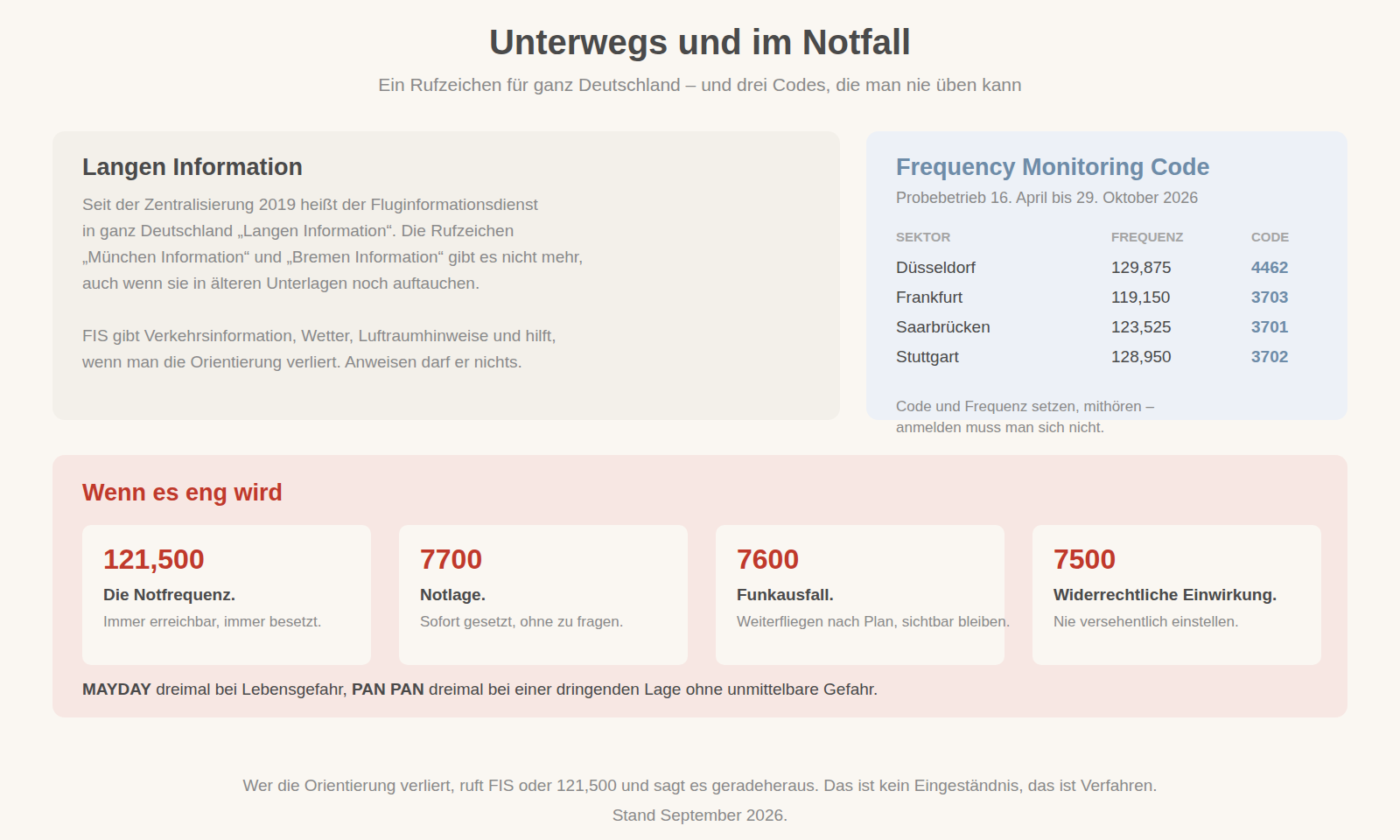
In 2019 the flight information service was concentrated at DFS headquarters in Langen. Since then a single callsign has applied nationwide: "Langen Information". The former regional callsigns "München Information" and "Bremen Information" no longer exist, even if they live on in older documents and in some memories. The frequencies themselves have remained the same and are on the chart.
FIS provides traffic information, weather and airspace notices and helps when you lose your orientation. It may not instruct you – it is not a controller. That is exactly why a call costs nothing but a few seconds.
The Frequency Monitoring Code
Because FIS is overloaded on good flying days, a trial procedure is running that makes the initial call unnecessary: you select the sector frequency, set a fixed transponder code and listen. That signals a continuous listening watch without loading the frequency with a call-in – FIS calls you if there is something.
The extended trial runs from 16 April to 29 October 2026 with four sectors: Düsseldorf 129.875 with code 4462, Frankfurt 119.150 with 3703, Saarbrücken 123.525 with 3701 and Stuttgart 128.950 with 3702. When changing sector you switch over unprompted, and when finishing you go back to 7000. A Mode S transponder with altitude reporting is required.
For flights in south-eastern Bavaria the procedure is currently not applicable – there the normal call to Langen Information remains. Heading west, however, you soon reach one of the four sectors.
When things get tight
- 121.500 – the emergency frequency. Always reachable.
- 7700 – emergency. Set it without asking first.
- 7600 – radio failure. Continue according to plan and stay visible.
- 7500 – unlawful interference. Never set it by mistake.
MAYDAY three times in danger to life, PAN PAN three times for an urgent situation without immediate danger. Then: who, what, where, how high, how many on board, what you intend to do.
What this means for a flying day
- Call FIS before you need it. If you are already in contact, in an emergency you only have to say what is happening.
- Prepare the sector frequency, do not search for it. It belongs on the flight log just like the airfield frequency.
- If you lose your orientation, report it early. The sooner you do, the larger the area in which you can still decide for yourself.
- Know the four numbers by heart. In an emergency you do not look things up.
As of September 2026. The Frequency Monitoring Code trial is time-limited; the current sectors and codes are in the DFS AIC VFR.
Remember
There is only one callsign en route: Langen Information. And it costs nothing to use it before you need it.