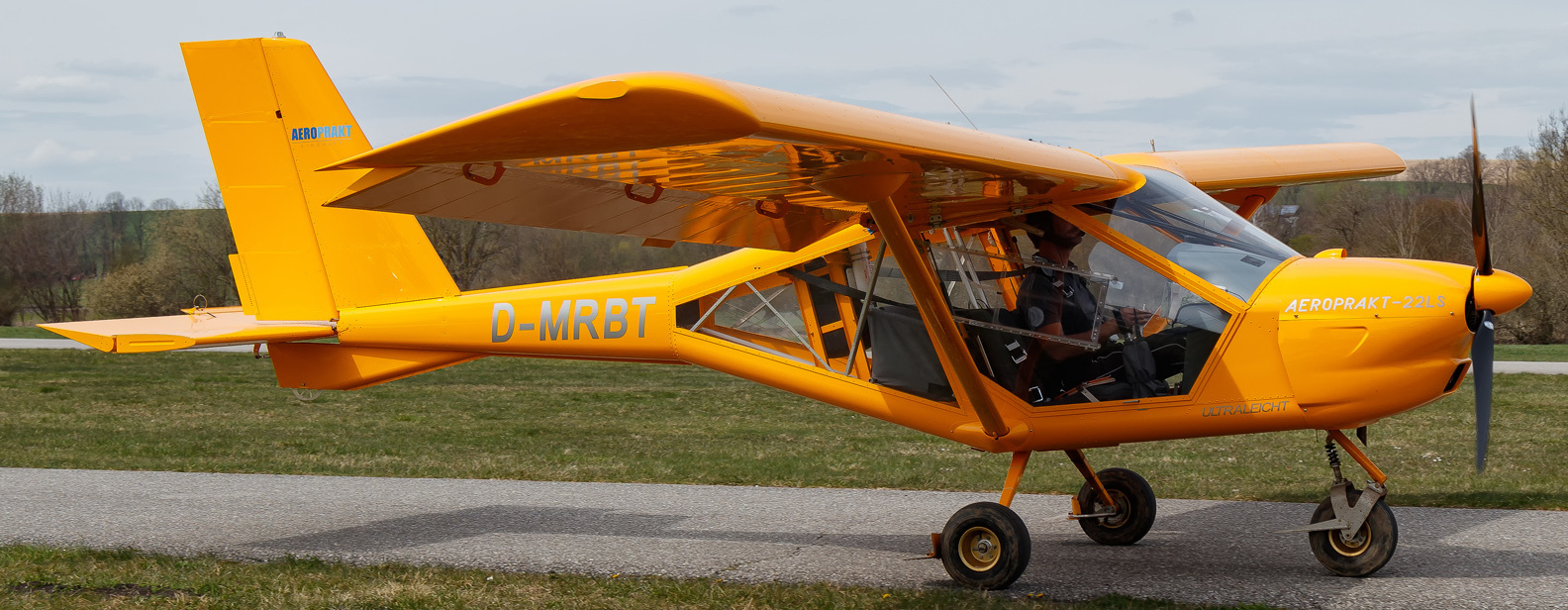
Being seen is not one question but two separate ones. Air traffic control listens on 1090 megahertz, the glider pilot soaring the ridge on 868. If you only have one of them on board, you are missing from the other world.
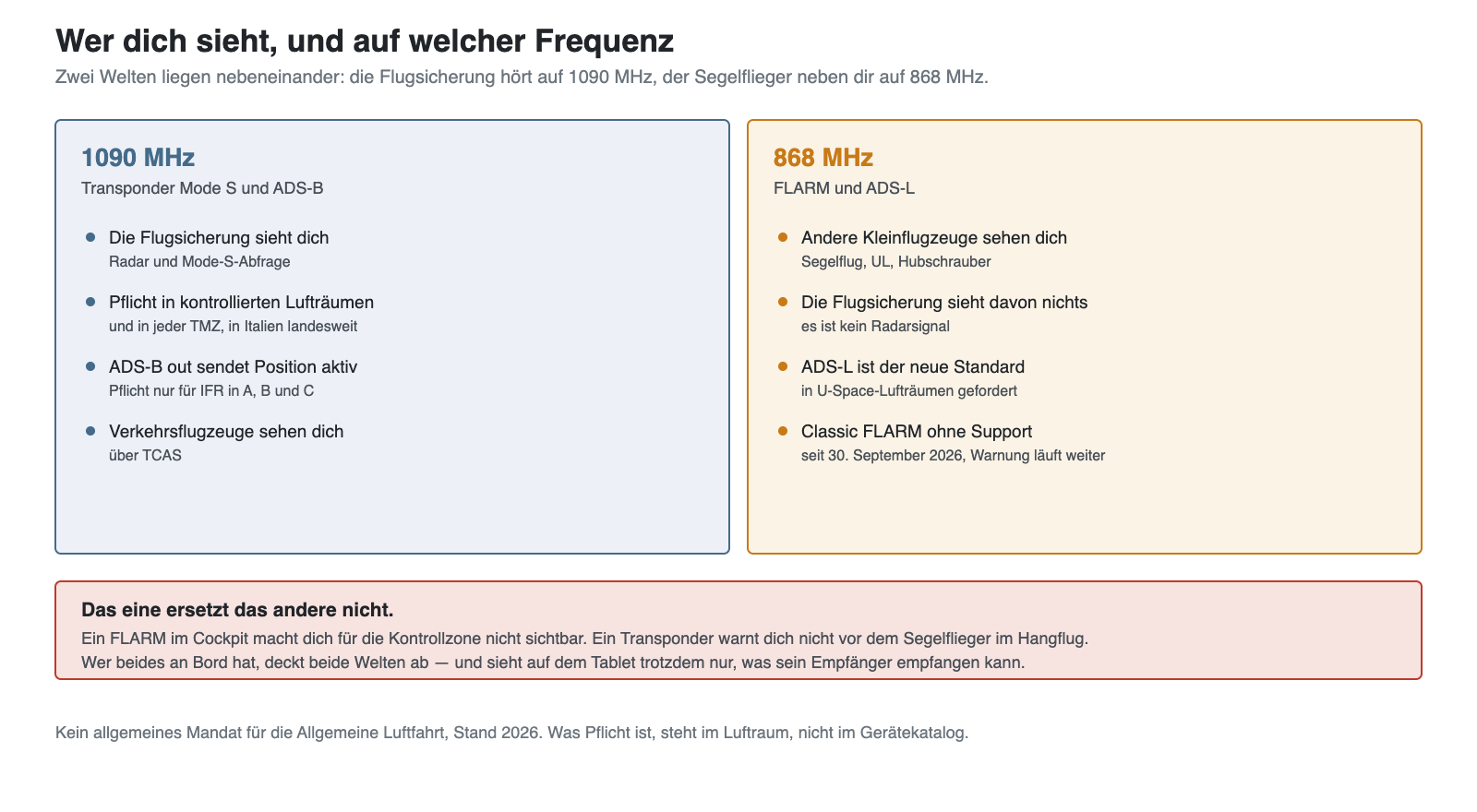
As of: September 2026. The field is in flux; obligations arise from the airspace and from European law, not from the equipment catalogue. Before the flight the current chart applies, before installation the advice of your inspector.
1090 megahertz: the transponder
Mode S is what air traffic control sees you with. It is mandatory in controlled airspace and in every transponder mandatory zone; in Italy the entire FIR is designated a TMZ, so it applies everywhere there. Airliners see you via their collision avoidance system, which uses the same channel.
ADS-B out goes one step further: instead of just replying, the aircraft actively transmits its position. In Europe this is mandatory for IFR traffic in classes A, B and C — so not for us, but it makes you visible to every receiver listening on 1090.
868 megahertz: FLARM and ADS-L
This band is where visibility among light aircraft happens. FLARM has been the standard in gliding and in large parts of the ultralight scene for years; ADS-L is the newer, open successor standard that newer devices also transmit. In U-space airspace European law requires electronic conspicuity, and ADS-L is a recognised means there.
Important for your expectations: air traffic control sees none of this. It is not a radar signal and not a reply to an interrogation, but a signal from aircraft to aircraft.
One does not replace the other
A FLARM in the cockpit does not make you visible to the control zone, and a transponder does not warn you of the glider on the ridge. The two systems solve different problems: one gets you your clearance, the other keeps you from a collision.
What you see on the tablet
The traffic display in the apps is only as good as the receiver feeding it. A device that only receives 868 shows no airliners; one that only receives 1090 shows no gliders. And anything that nobody transmits appears nowhere — the black biplane without electrics stays invisible.
This leads to the only reliable rule: the display supplements the look outside, it does not replace it.
Classic FLARM and the end of support
For the first FLARM generation, support ended on 30 September 2026. The devices still warn, but no longer receive updates or new obstacle data. Anyone with such a device on board should know they are flying a frozen system.
What this means for a flying day
- Transponder on as soon as the chart requires it — and in Italy from the border onwards.
- Code 7000 as long as nobody is providing you with a service, and the assigned code as soon as someone is.
- Know what your receiver can do. An empty traffic display does not mean the sky is empty.
- On the ridge and in the circuit 868 counts, not 1090.
- Installation and inspection are part of the device. Anything that transmits must be approved and correctly coded.
Remember
1090 is for air traffic control, 868 for the traffic next to you. Only both together give a picture, neither alone.